Acrylic Prints for Photographers and Artists: A Guide to Selling Them Without an Acrylic Printer
Why acrylic sells as a premium format, which images suit it, how to prepare files for A4, A3 and A2 cast acrylic, and how trade printing works if you don't own the printer.
Most photographers and artists who sell prints offer paper, canvas and perhaps framed. Acrylic is often missing from the list, usually because it needs a specialist printer and outsourcing it through a general lab makes it slow and expensive.
This guide is for anyone selling their own work who is considering adding acrylic: what it does to an image, which pictures suit it, how to prepare files, and how trade printing works.
If you are buying a print for your own wall rather than selling one, our framed, canvas or acrylic comparison is the better read.
What Acrylic Does to an Image
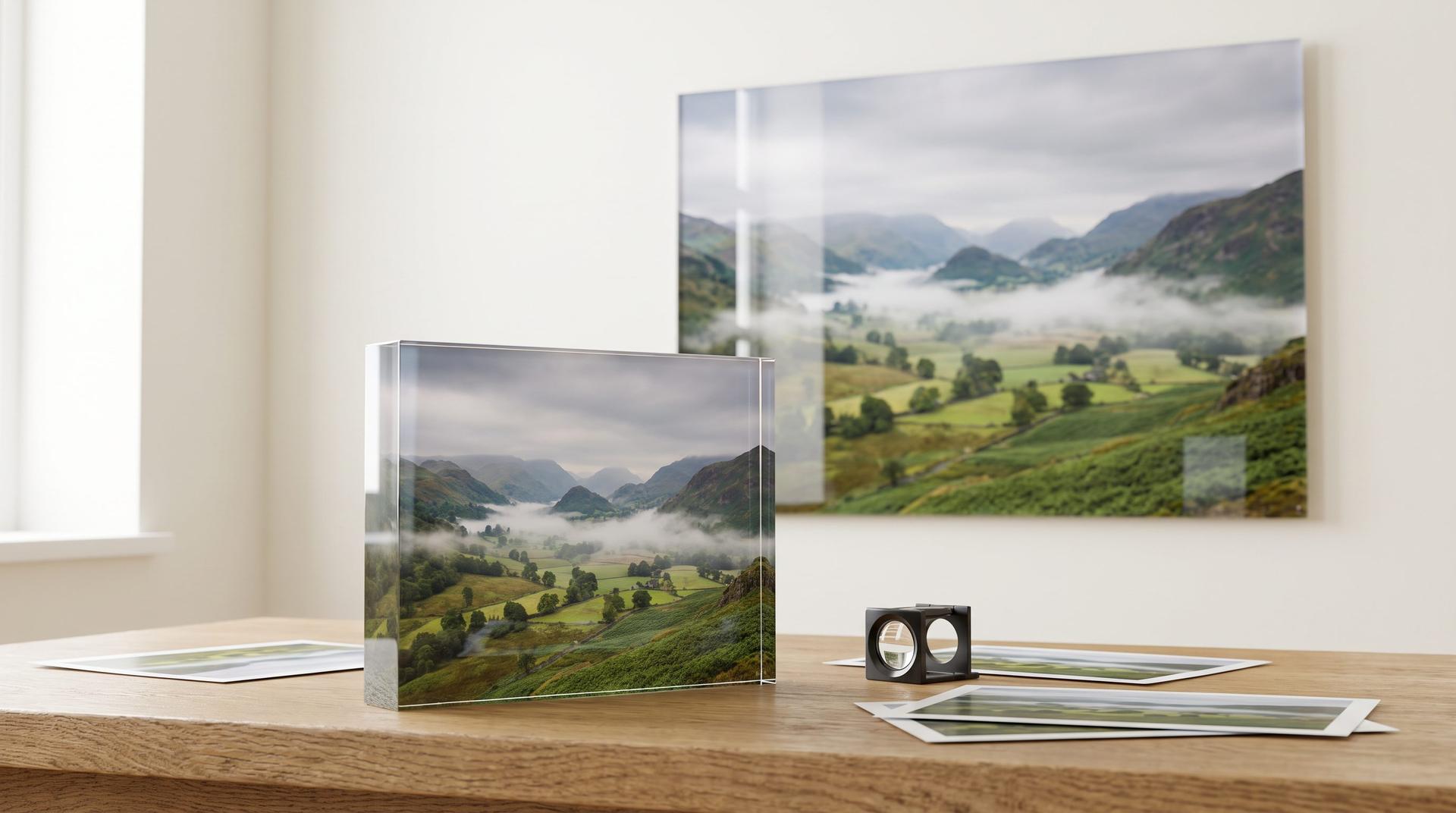
We UV-print the image directly onto cast acrylic, and the result has depth that paper behind glass does not. Colour looks richer, blacks look deeper, and the edges of the panel catch the light. There is no frame and no mount, so the image runs edge to edge.
There is a second effect that paper can't reproduce. Any area left unprinted stays clear, so a design on a transparent background appears to float off the wall. That suits line drawings, illustrations and graphic work especially well.
Which Images Suit Acrylic?
- Landscapes with depth and atmosphere, such as mist, water and long views. The format adds a sense of looking through a window.
- Strong colour and contrast. Saturated sunsets, city lights at night and bold illustration benefit most.
- Panoramics. A long, thin panel without a frame reads more like architecture than a picture.
- Line work and graphic art, using the clear areas described above.
The images that suit it least are soft, muted pieces that rely on the texture of a fine-art paper. Keep those on paper. Acrylic works best as an extra tier in your range, not a replacement for what already sells.
Sizes and Files
We print cast acrylic in three sizes:
| Size | Dimensions | Pixels at 300 ppi |
|---|---|---|
| A4 | 210 x 297mm | 2480 x 3508 |
| A3 | 297 x 420mm | 3508 x 4961 |
| A2 | 420 x 594mm | 4961 x 7016 |
The pixel figures are a target, not a hard rule. A sharp file somewhat below that will still print well at A2, because acrylic is viewed from further away than a book. What does not survive is a file that has been compressed. The most common cause is an image sent through a messaging app, which we explain in choosing a photo that prints well.
Send the full-resolution export as a TIFF, or as a high-quality JPEG in sRGB. If you want unprinted areas left clear, send a PNG with a transparent background and say so.
If you're unsure how big A2 really is on a wall, our wall art size guide puts it in everyday terms.
How Trade Printing Works
We have just installed a Roland MO-240 that prints an A2 HD cast-acrylic panel in under thirty minutes. That makes it practical for us to print to order for people who sell their own work. We explain the machine in what the MO-240 changes.
The arrangement is simple:
- You send your files and the sizes you need.
- We print from your own files and check the result before it is packed.
- You set your own retail price. Trade pricing is on request.
Production is 1-4 working days, and UK delivery is a further 1-3 working days after dispatch.
Our trade printing page has the details and a quote form. For a sense of how we print paper and canvas in the same workshop, see bringing printing in-house.
Pricing Acrylic in Your Own Range
Acrylic usually sits above framed prints, because the material costs more and the finish looks more expensive. A practical way to price it is to start from your framed price at the same size and add a premium for the format. Then check that your margin still holds once the trade print cost and postage are included.
Offer acrylic on your best-selling images first before rolling it out across the whole catalogue. You will learn quickly which pictures people want in the format, and you can expand from there.
Frequently Asked Questions
Q: What sizes of acrylic print can you make? A: A4, A3 and A2 cast acrylic. A2 is 420 x 594mm.
Q: Do you offer trade pricing for photographers and artists? A: Yes, on request. Send your sizes and quantities through our trade printing page.
Q: What resolution do I need for an A2 acrylic print? A: Around 4961 x 7016 pixels at 300 ppi is ideal. Sharp files somewhat below that still print well. Compressed files, such as images sent through messaging apps, do not.
Q: Can parts of the acrylic be left clear? A: Yes. Any area left unprinted stays clear, so artwork on a transparent background appears to float.
Q: How long does a trade acrylic order take? A: Production is 1-4 working days and UK delivery is 1-3 working days after dispatch.
Written by
Andrew
Content Team
Part of the Keep It What team, dedicated to helping you create meaningful personalised gifts.